
Which Number Grows Best
As your company grows, considering a change from cash to accrual accounting for tax purposes, for sale preparations and to improve financial reports will provide greater insights into your financial position, cash flows and operations results. Is it time to trade-in the cigar box?
Transitioning from cash to accrual is a practical strategic business decision that can significantly impact your company’s growth trajectory, funding opportunities, and operational efficiency. If your business generates between $1MM and $25MM annually, then this article is for you. There is a strategic window where you can optimize both your business insights and your tax treatment as long as you make the right moves at the right time.
It’s important to have a practical decision-making conversation with your CPA and perhaps a tax attorney. Share your thoughts and listen to their recommendations. Most businesses benefit from expert analysis of compliance requirements, tax optimization opportunities, and strategic business objectives. There’s a step-by-step conversion process with specific considerations they can guide you to make the best informed choice aligned with your specific goals and growth plans. Regardless what decision you choose, you’ll feel empowered to use whichever accounting method as a strategic tool for business success.
What’s the Difference?
Cash Accounting = When Money Changes Hands
-Record revenue when you receive payment
-Record expenses when you pay bills
-Simple and straightforward
Example: You invoice $5,000 in December but get paid in January, revenue shows up in January
Accrual Accounting = When Work is Done
-Record revenue when you earn it (send invoice)
-Record expenses when you incur them (receive bill)
-More complete financial picture
Example: Same $5,000 invoice, revenue shows up in December when you completed the work
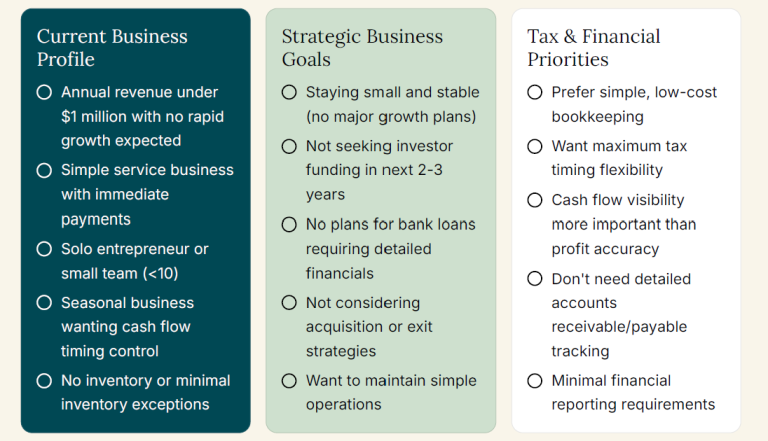
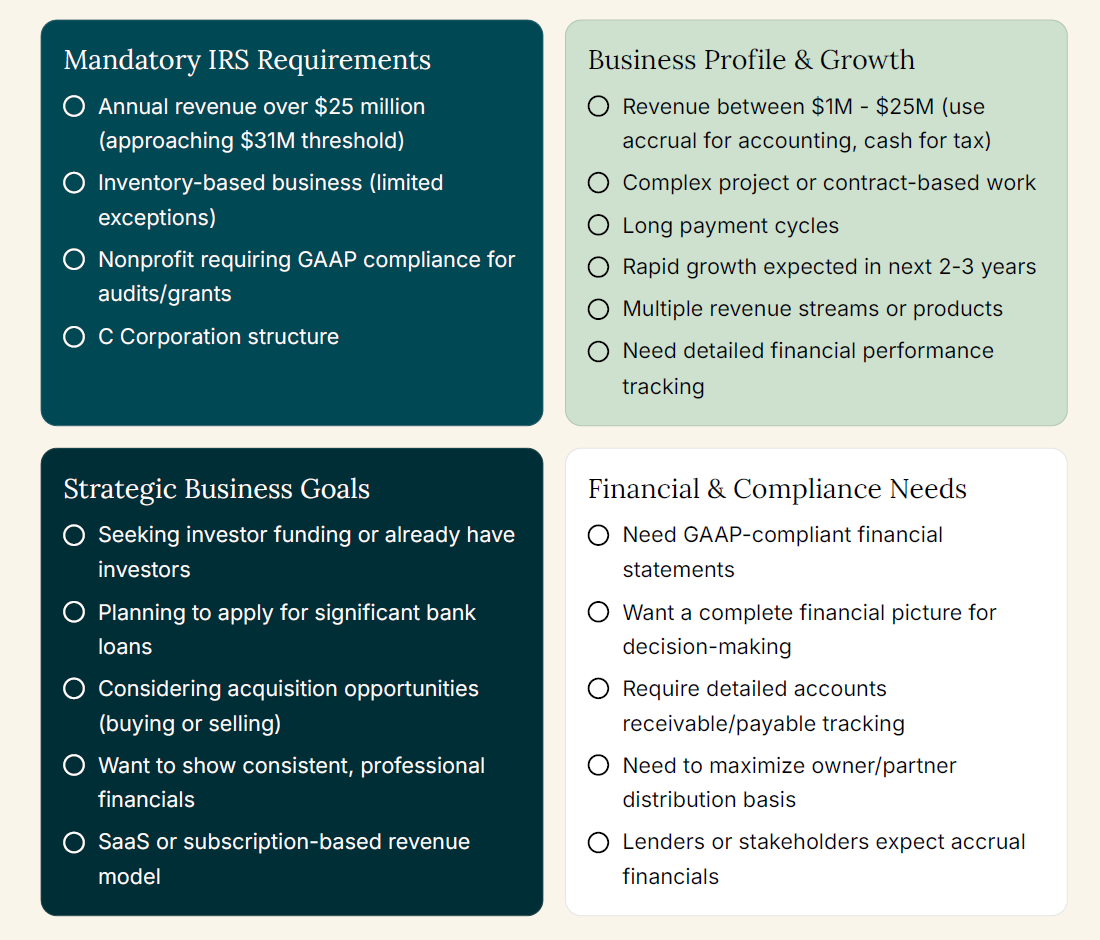
Review both checklists below and count how many items apply to your business. The checklist with more applicable items likely indicates the better accounting method for your situation. Check all that apply and total up each accounting method score.
Choose Cash Accounting
Choose Accrual Accounting
Your Results Tell You:
Higher Cash Score – Cash accounting likely fits your current needs
Higher Accrual Score – Accrual accounting better supports your goals
Close Scores – Consider staying with cash and plan a transition to accrual
Checked Any Mandatory Requirements? Once you’re moving beyond $25MM accrual may be required
Nearly all small businesses – consistently generating less than $3MM – aren’t ready to make such a transition. However, those businesses trending beyond $4MM and annualizing $5- or $7MM are considered in the sweet spot of revenue growth for SMBs. An optimal strategy would be to convert to accrual accounting internally for superior business decision making while maintaining cash basis tax benefits. Here’s where wisdom lies with your CPA, tax attorney and wealth advisor.
The Missed Hidden Opportunity
And why many businesses in the $1M-$25M range continue using cash accounting because “it’s simpler’ miss the point as years of better financial insights can and will accelerate growth. Others switch incorrectly and lose valuable tax advantages unnecessarily. Whether you’re just on the shoulder of your business career or you’re weighing your options of selling or succession planning within the next 7-10 years, educate yourself and listen to business professionals engaged on a daily basis with similar situations are yours. What should you do? Talk to your CPA or tax attorney.
The Risk of Waiting
The closer you get to $15MM and $25MM, the more rushed and reactive your conversion becomes. Companies that wait until $20M+ often make costly mistakes during the transition that could have been avoided with strategic planning. Remember: once you switch accounting methods, you’re locked in for 5 years. The IRS requires
legitimate business reasons, not short-term tax benefits. Getting ahead of an important decision rather than reacting to requirements gives you more options and better outcomes. Even if you qualify for cash accounting, you may still benefit from accrual if you’re planning to scale, need financing, or want more detailed financial insights for decision-making. Have that conversation today!
